Goals of the Session
- Introduce the mathematical concept of Linear Transformations.
- Prove whether a function is a linear transformation.
- Calculate fundamental subspaces: Kernel (Null Space) and Image (Range).
- Understand and apply the Dimension Theorem (Rank-Nullity).
Motivation: Process Inputs to Outputs
A factory transforms 3 raw materials into 2 finished product types via a linear mapping represented by:
$$T = \begin{pmatrix} 1 & 2 & 0 \\ 3 & 0 & 1 \end{pmatrix}$$
- What raw material combinations yield zero net output ($\text{Ker}(T)$)?
- What finished product combinations can actually be manufactured ($\text{Im}(T)$)?
Definition of Linear Transformation
Definition: Let $V$ and $W$ be vector spaces. A function $T: V \to W$ is a linear transformation if for all $u, v \in V$ and $\alpha \in \mathbb{R}$:
- Additivity: $T(u + v) = T(u) + T(v)$
- Homogeneity: $T(\alpha u) = \alpha T(u)$
Or equivalently: $T(\alpha u + \beta v) = \alpha T(u) + \beta T(v)$.
The Kernel (Null Space)
Definition: The Kernel (or Null Space) of $T: V \to W$, denoted $\text{Ker}(T)$, is the set of all vectors in $V$ that map to zero in $W$:
$$\text{Ker}(T) = \{ v \in V \mid T(v) = 0 \}$$$\text{Ker}(T)$ is a subspace of the domain $V$.
Kernel Visualization
Watch how vectors in the kernel of $T(x,y) = (2x+y, 4x+2y)$ all map to zero:
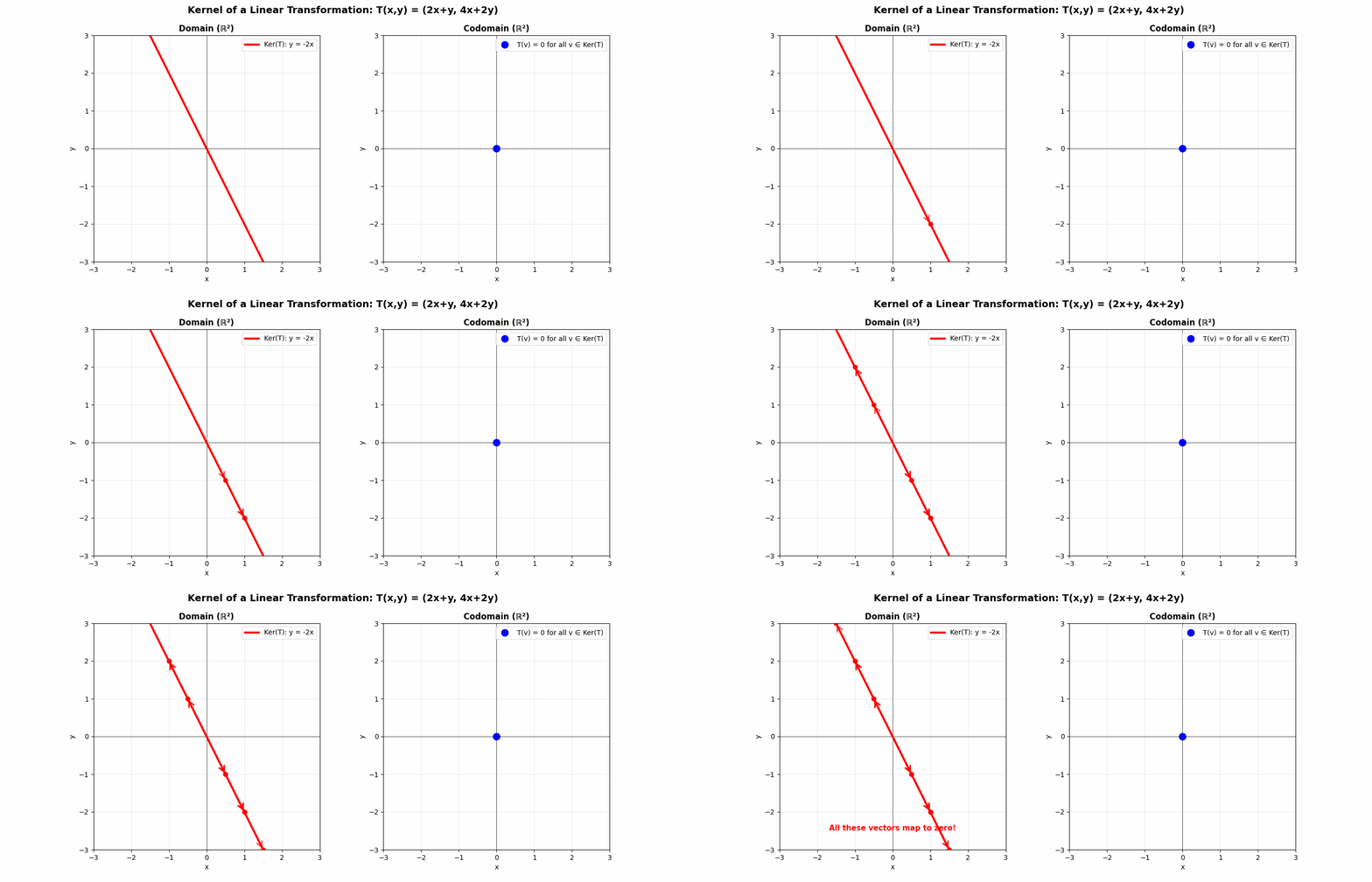
Red vectors in domain form the kernel; they all map to the origin in the codomain
The Image (Range)
Definition: The Image (or Range) of $T: V \to W$, denoted $\text{Im}(T)$, is the set of all output vectors in $W$ attained by $T$:
$$\text{Im}(T) = \{ T(v) \in W \mid v \in V \}$$$\text{Im}(T)$ is a subspace of the codomain $W$.
Image Visualization
Watch how domain vectors map to the image of $T(x,y) = (x+2y, x+2y)$:
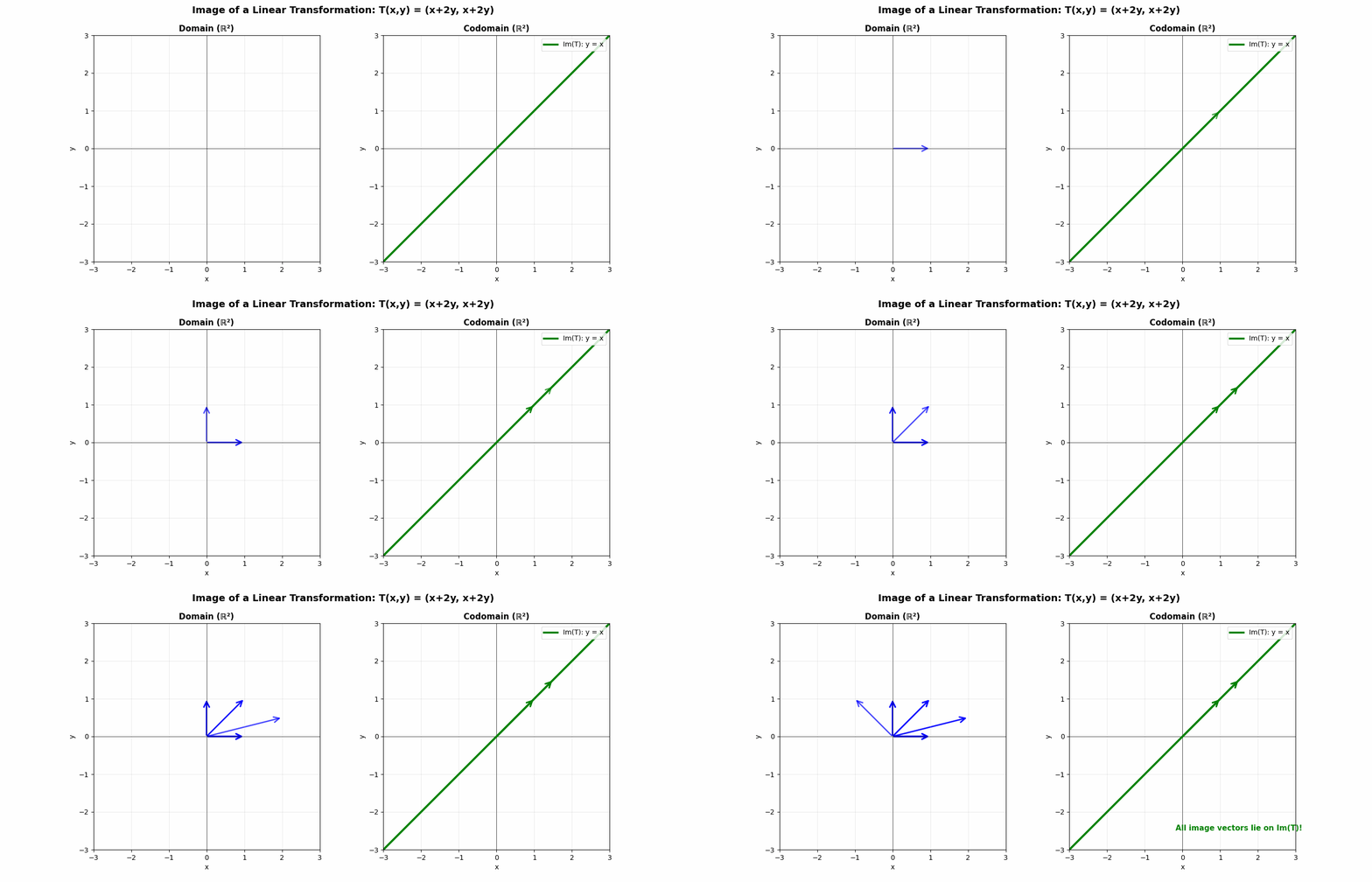
Blue vectors in domain map to green vectors; all image vectors lie on the line $y=x$
The Dimension Theorem (Rank-Nullity)
Theorem: Let $V$ be a finite-dimensional vector space and $T: V \to W$ a linear transformation. Then:
$$\text{dim}(V) = \text{dim}(\text{Ker}(T)) + \text{dim}(\text{Im}(T))$$- $\text{nullity}(T) = \text{dim}(\text{Ker}(T))$
- $\text{rank}(T) = \text{dim}(\text{Im}(T))$