Goals
- Understand how is made a general solution of a non-homogenous LODEs with cc.
- Describe the function models and the relation with the non-homogenous term.
- Describe the method of undetermined coefficients.
- Apply the undetermined coefficients method to solve non-homogenous LODEs with cc.
Recall:
A non-homogeneous LODEs with cc is of the form $$a_ny^{(n)}+a_{n-1}y^{(n-1)}+\cdots+a_2y''+a_1y'+a_0y=g(x),$$ where $a_n,a_{n-1},\cdots,a_2,a_1,a_0$ are constants and $g(x)$ is a function.
The particular solution for a non-homogeneous ODE is made by the sum of the general solution of the homogeneous ODE and a particular solution of the non-homogeneous ODE.
From now, we will focus on non-homogeneous LODEs with cc therefore we will omit the "non-homogeneous" word.
Some assumptions:
The function $g(x)$ could be any type of function, but we will only consider the following ones:
- Polynomials (including constants) $$g(x)=c_0+c_1x+c_2x^2+\cdots+c_nx^n.$$
- Exponentials: $$g(x)=e^{cx}$$
- Sines or Cosines: $$g(x)=\sin(cx)\mbox{ or } g(x)=\cos(cx).$$
- Combinations of these (product and/or sums): $g(x)=10,$ $g(x)=15x-6+8e^{-x}$ o $g(x)=xe^x \sin(x)+(3x^2-1)e^{-4x}.$
The method of undetermined coefficients:
The method is applied for non-homogeneous LODEs with cc and the non-homogeneous term is a function $g(x)$ as in the list above.
The idea behind this method:
"the derivatives of functions $g(x)$ as in the list above, are combinations of functions in the list.
The method of undetermined coefficients:
- Find the general solution of the homogeneous LODEs with cc.
- For the particular solution, find a model function $y_p(x)$ and substitute it into the LODEs with cc.
- From the fact that we are assuming that is a solution, it must satisfies the LODEs with cc.
- The substitution will lead us to a system of equations for the coefficients of the model function.
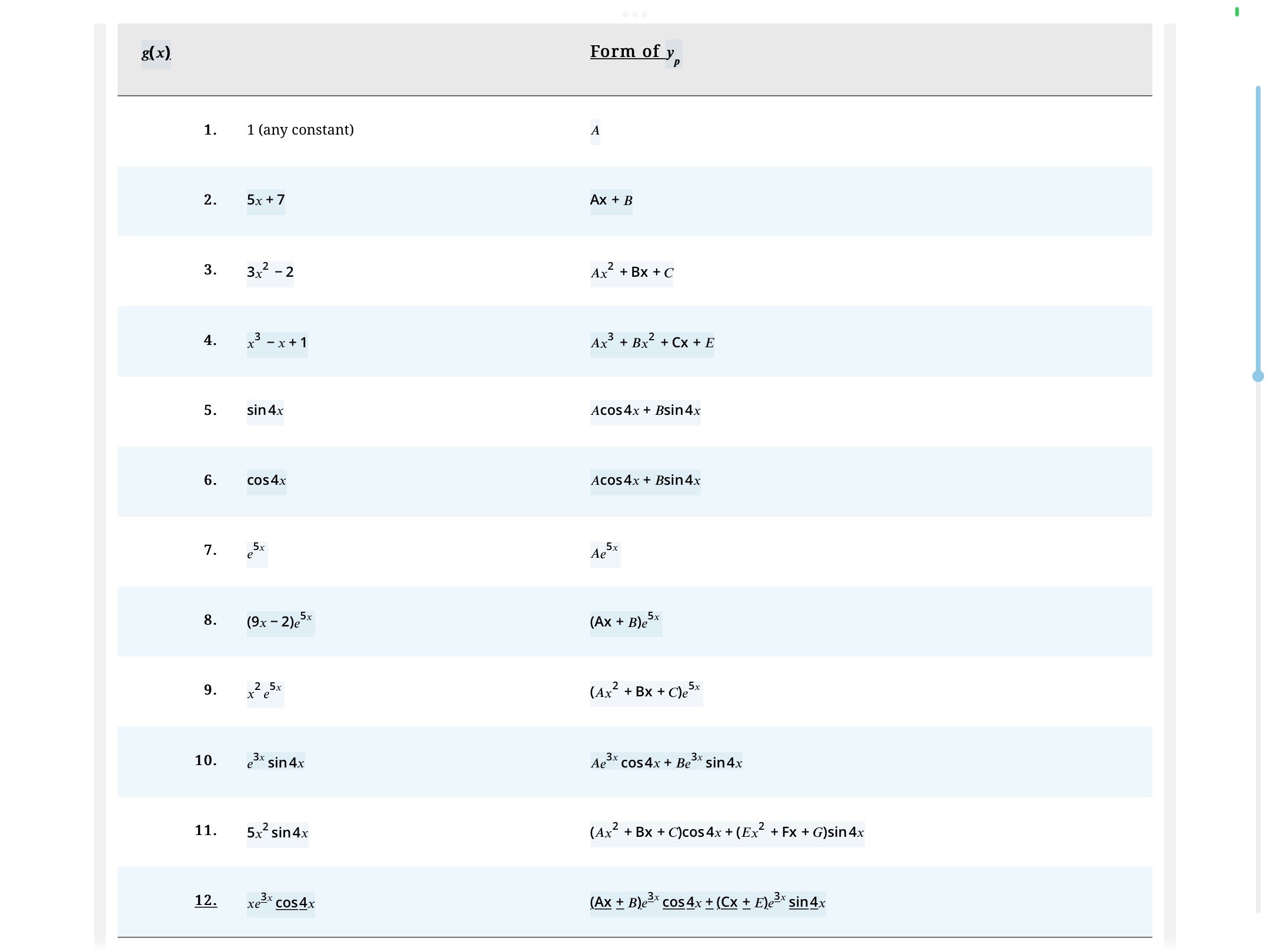
Example 1:
Find the particular solution of $y''+4y'-2y=2x^2-3x+6.$
Solution Example 1:
- From the fact that $g(x)$ is a polynomial of degree two, then the particular solution could be a polynomial of degree two (equal), let's assume that is $$y_p=Ax^2+Bx+C.$$
- Substituting $y_p$ in the LODEs with cc: $y_p'=2Ax+B$ and $y_p''=2A$ then $$2A+8Ax+4B-2Ax^2-2Bx-2C=2x^2-3x+6.$$
- Solving the system of equations we get $A=-1,$ $B=-\frac{5}{2}$ and $C=-9.$
- Therefore $y_p=-x^2-\frac{5}{2}x-9.$
Example 2:
Find the general solution to $y''-y'+y=2\sin(3x).$
Solution Example 1:
- From the fact that $g(x)=2\sin(3x)$ is a sine function, then the particular solution could be a sine function but the derivatives of $\sin(x)$ involve $\cos$, let's assume that is $$y_p=A\sin(3x)+B\cos(3x).$$
- Substituting $y_p$ in the LODEs with cc: $y_p'=3A\cos(3x)-3B\sin(3x)$ and $y_p''=-9A\sin(3x)-9B\cos(3x)$ then $$-9A\sin(3x)-9B\cos(3x)-3A\cos(3x)+3B\sin(3x)+A\sin(3x)+B\cos(3x)=2\sin(3x).$$
Example 2:
- We obtain the following system of equations: $$\begin{cases} -8A+6B=0 \\ 6A+8B=2 \end{cases}.$$ Solving the system we get $A=\frac{3}{10}$ and $B=\frac{1}{10}.$
- Therefore the particular solution is $y_p=\frac{3}{10}\sin(3x)+\frac{1}{10}\cos(3x).$
- The general solution is $y=y_h+y_p=C_1e^x+C_2e^x+\frac{3}{10}\sin(3x)+\frac{1}{10}\cos(3x).$
An error in the matrix
Find the solution for $$y''-5y'+4y=8e^x.$$
Now try with the following model function: $$y_p=Axe^x.$$
Example 3:
Find the particular solution to $y''-2y'-3y=4x-5+6xe^{2x}.$ In this case the particular solution should be of the form: $$y_p=Ax+B+Cxe^{2x}+Ee^{2x}.$$